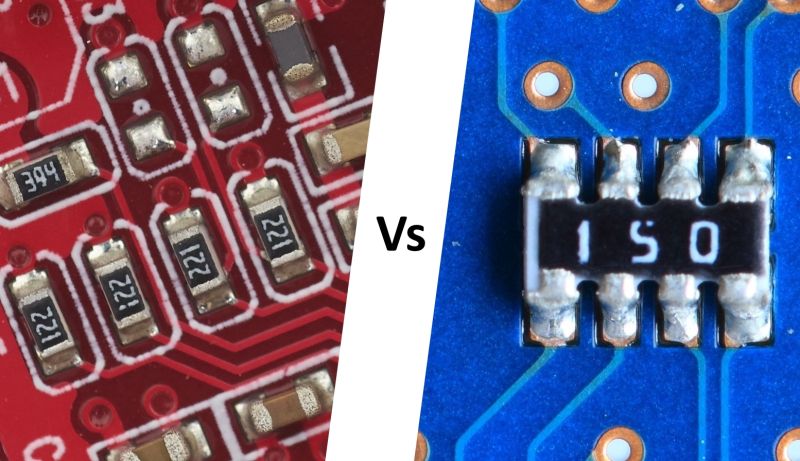
Last week I posted a photo of computer RAM, in which a special component caught my attention. On the blue PCB (printed circuit board), you can see a resistor array containing four resistors of the same value (15 ohm). This is less common than single resistors, such as the four seen on the red board (marked 221, which means 220 ohm). But why choose either one?
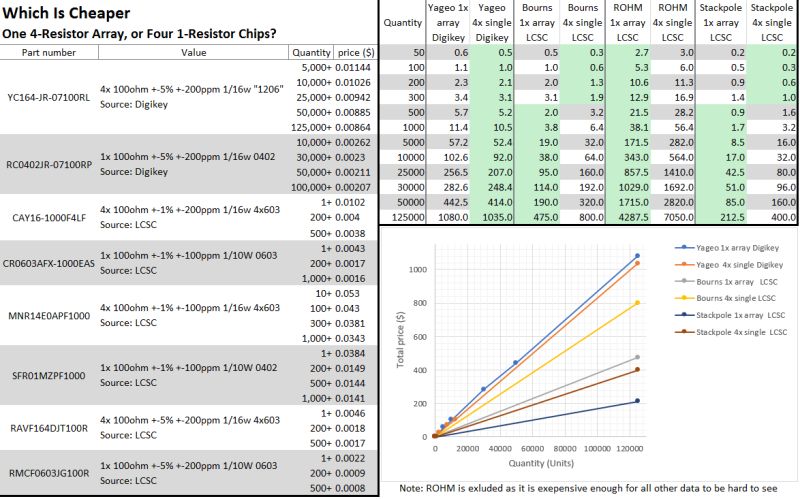
I had previously heard from an experienced engineer that a resistor array can be cheaper, but I wanted to check this claim. I used digikey (American) and LCSC (Chineese) websites to compare, first finding an array, then comparing it to buying four of the closest compareable single resistor. The result of this can be seen in photo 2, in which we can see that in come cases, especially at a higher order amount, the array is indeed cheaper. If a board needs 100 resistors of the same value, and a million units are made over its lifetime, $37,500 can be saved (using 25 stackpole arrays instead of 100 stackpole resistors).
One more reason resistor arrays can be cheaper is the fact that they only require one placement in the pick and palce machine, in low production runs this doesnt mean much, but if the machine is working 24/7 on one single design, it can quickly add up.
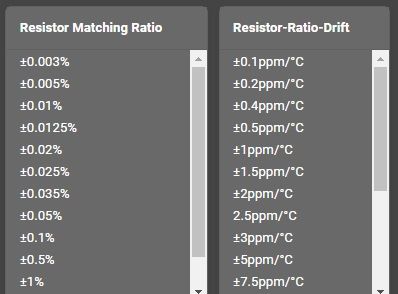
When I posted last week, I was expecting cost to be the primary driver for using arrays, but Eng. Eyas Alsuhaibani pointed out that having the resistors be in an array means that they are better matched. Indeed, as seen in the last photo, arrays can be purchased with specific matching tolerances. Why does this matter? Because even a 0.1% resistor can mean that there is a 0.2% difference, and if the difference between the parts is more important than the absolute resistance, then an array is the better choice.
One reason not to use resistor arrays is that some parameters may not be avaiable, such as low temperature coeffeiceint (200 ppm seems to be the most common, with some 100 ppm parts available, with only one vendor supplying 0.1-1 ppm). This should not matter in most cases, but calculation is necessary to ensure proper device operation.
I have seen many parts such as diodes, mosfets, LEDs, etc in which multiple ones are packaged together, but this seems much less prevalent in capacitors (a capacitor array could be used for things like PCIe, where every device needs DC blocking capacitors). I think it may have to do with crosstalk, what do you think the reason may be?